





Seminarios de investigación

Accede a los seminarios de investigación celebrados en el Museo Nacional de Ciencias Naturales.

Seminarios de investigación en el canal Youtube del MNCN


Próximos


MARZO


Encuentros de Biología Teórica

ONDAS EN EL CEREBRO: DE REDES NEURONALES A DINÁMICAS DE CONTINUO

cartel de la charla impartida por Joana Cabral

Ponente: Joana Cabral

Fecha y hora: martes 24 de marzo de 12:00 a 13:00

Lugar: salón de actos del MNCN

Resumen: La neurociencia moderna enfrenta el desafío de comprender cómo emergen los procesos cognitivos complejos desde la actividad coordinada de miles de millones de neuronas. Tradicionalmente, el cerebro se ha conceptualizado como una red de unidades discretas interconectadas. Sin embargo, evidencia experimental reciente está provocando una revisión fundamental de este paradigma, sugiriendo que la dinámica cerebral puede entenderse mejor como ondas que se propagan a través de un continuum neural.
En esta charla, presentaré cómo integrar perspectivas teoricas de física y matemáticas en la biología para abordar preguntas fundamentales sobre la organización funcional del cerebro. Mostraré cómo principios universales de la mecánica clásica —como resonancia, modos armónicos y propagación de ondas— pueden explicar patrones observados en neuroimagen y electrofisiología. Discutiré experimentos que revelan la naturaleza oscilatoria de la actividad cerebral y cómo estas oscilaciones coordinadas sustentan procesos cognitivos.
Este cambio de paradigma abre camino a una interpretación de la cognición como un fenómeno colectivo emergente en un sistema dinámico, que opera a una escala muy distante de las neuronas individuales, que depende de caracteristicas estruturales macroscopicas y que puede ser caracterizado usando herramientas de la teoría de sistemas dinámicos y la superposición de ondas.


ABRIL


GRITANDO A LOS CUATRO VIENTOS: THE EMERGENCE OF AIRBORNE EDNA ANALYSIS

cartel del seminario imaprtido por Matthew A Barnes

Ponente: Matthew A Barnes, Associate Professor. Department of Natural Resources Management Texas Tech University, Lubbock, Texas, USA

Fecha y hora: viernes 10 de abril de 12:00 a 13:00

Lugar: salón de actos del MNCN

Abstract: Trained as an aquatic community ecologist, Dr. Matthew Barnes increasingly finds himself applying environmental DNA methods (the collection and identification of genetic material that organisms shed into their environment in the form of sloughed cells and other wastes) in non-aquatic habitats. In this seminar, Barnes will describe his entry into the field of airborne environmental eDNA. Barnes has emerged as a leader in this burgeoning field, and will discuss its potential the benefit the study and management of terrestrial plants and animals, and maybe even more!


HOW NATURAL SYSTEMS BECAME BIOLOGICAL AGENTS THROUGH THE GENERATION, MAINTENANCE AND RELIABLE PROPAGATION OF FUNCTIONAL CONSTRAINTS

cartel del seminario impartido por Kepa Ruiz

Ponente: Kepa Ruiz Mirazo

Fecha y hora: viernes 17 de abril de 12:00 a 13:00

Lugar: salón de actos del MNCN

Abstract: The origin-of-life problem has been traditionally conceived as the chemical challenge to find the type of molecules and free-solution reaction dynamics that got Darwinian evolution started. Thus, in the last decades, different autocatalytic and ‘self-replicative’ molecular species have been extensively investigated, together with plausible synthetic pathways leading, abiotically, to such a minimalist scenario. However, in addition to molecular kinetics or molecular evolutionary dynamics, other physical and material constraints (like compartmentalization, differential diffusion, selective transport, osmotic forces, energetic couplings) seem to have been crucial for the cohesion, functional integration, and intrinsic stability/robustness of intermediate systems “in-between” chemistry and biology. In this seminar, I will present a protocellular scenario where some of those additional constraints/mechanisms are addressed, demonstrating their ‘system-level’ implications, both inward (individual organization) and outward (collective, ecological and evolutionary, networks).


Ponente:

Fecha y hora: viernes 24 de abril de 13:00 a 14:00

Lugar: salón de actos del MNCN


MAYO


ARE ECOSYSTEMS EVER “STABLE”? TOWARD A DIALECTICAL THEORY OF ECOLOGICAL CHANGE

cartel del seminario impartido por David G. Angeler

Ponente: David Angeler, Biogeoquímica y Ecología Microbiana, MNCN-CSIC

Fecha y hora: viernes 8 de mayo de 12:00 a 13:00

Lugar: salón de actos del MNCN

Abstract: What if ecosystems are not systems that move between stable states but are instead structured tensions that never truly stabilize? Ecology has long relied on concepts such as equilibrium, resilience, alternative stable states, and regime shifts. These frameworks have generated powerful empirical insights. Yet they often assume that stability is the norm and disruption the exception. In the Anthropocene, this assumption may no longer hold. In this seminar, I argue that ecosystems are fundamentally dialectical: they persist not because they reach balance, but because opposing processes (disturbance and memory, competition and cooperation, conservation and innovation) continuously generate each other. Stability, in this view, is not a resting point but a temporary condensation of deeper dynamic contradictions. Drawing on examples from temporary wetlands, shallow lakes, forests, coral reefs, and socio-ecological systems, I will explore how this perspective reshapes how we interpret regime shifts, biodiversity loss, evolutionary novelty, and management interventions. It challenges restoration as “return,” questions whether resilience always implies desirability, and invites us to rethink what we mean by ecological integrity. The aim is not to discard existing theory, but to test its limits; and to ask whether a dialectical framing might better integrate ecology, evolution, paleobiology, and governance under accelerating global change. If ecosystems are inherently tension-structured rather than equilibrium-bound, what does that imply for how we study, conserve, and manage them?


Encuentros de Biología Teórica

REGRESIÓN HACIA LA MEDIA: UN VIEJO PROBLEMA

cartel de la charla impartida por Mauro Santos

Ponente: Mauro Santos

Fecha y hora: martes 19 de mayo de 12:00 a 13:00

Lugar: salón de actos del MNCN


Ponente: Paola Laiolo

Fecha y hora: viernes 22 de mayo de 12:00 a 13:00

Lugar: salón de actos del MNCN


Ponente: Peter Convey

Fecha y hora: viernes 29 de mayo de 13:00 a 14:00

Lugar: salón de actos del MNCN


JUNIO


Ponente: Hernán Morales

Fecha y hora: viernes 19 de junio de 12:00 a 13:00

Lugar: salón de actos del MNCN


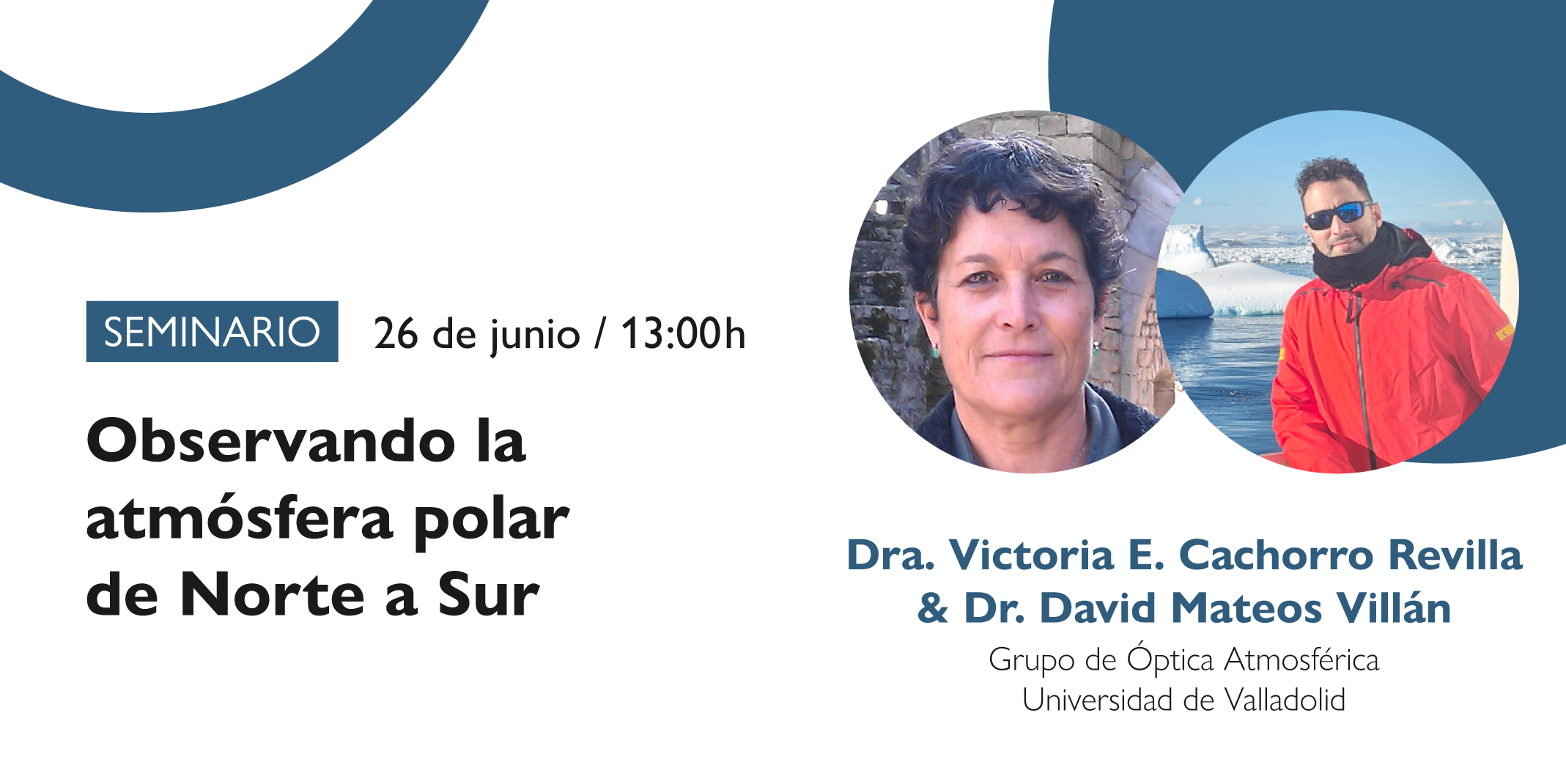
Ponente:

Fecha y hora: viernes 26 de junio de 13:00 a 1:00

Lugar: salón de actos del MNCN


Anteriores

2026

2025


2024

2023

2022

2021

2020

2019

2018

2017

2016

2015

2014

2013

2012

2011

2010


Galería multimedia